

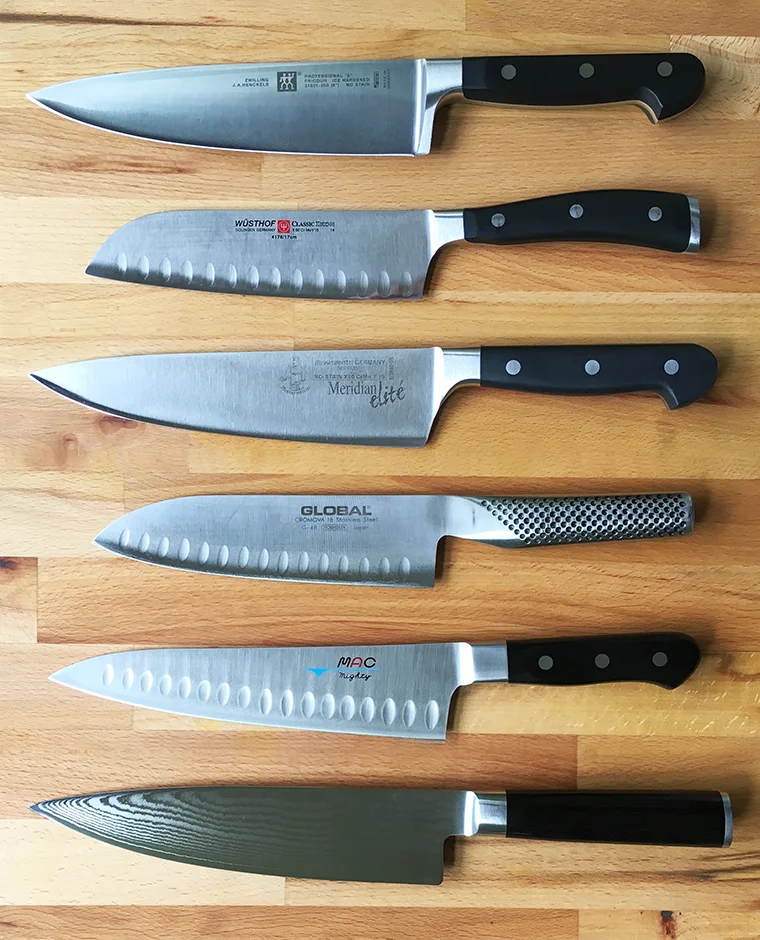
Manufacturing quality kitchen knives, especially hundreds at a time, is no simple task. It takes high-grade steel, skilled tradesmen, rigorous quality-control systems, and, ideally, your own heat-treating facilities (a very expensive proposition). Not all knifemakers are up to the task, especially a lot of newbie companies springing up like wildflowers. The kitchen knife brands in the list above—Zwilling J.A. Henckels, Wusthof, Messermeister, Global, MAC, and Shun—all have proven track records and lifetime warranties. Some have been making knives for hundreds of years.
The first three brands are centered in Germany, the last three in Japan. I have purposely contrasted German chef knives to Japanese in order to expose you to the two major approaches to kitchen knifemaking in the world today. Most chef knives you come across today are either from one tradition or the other, or are a blend. If you’re curious and want more on this, click on down the page.
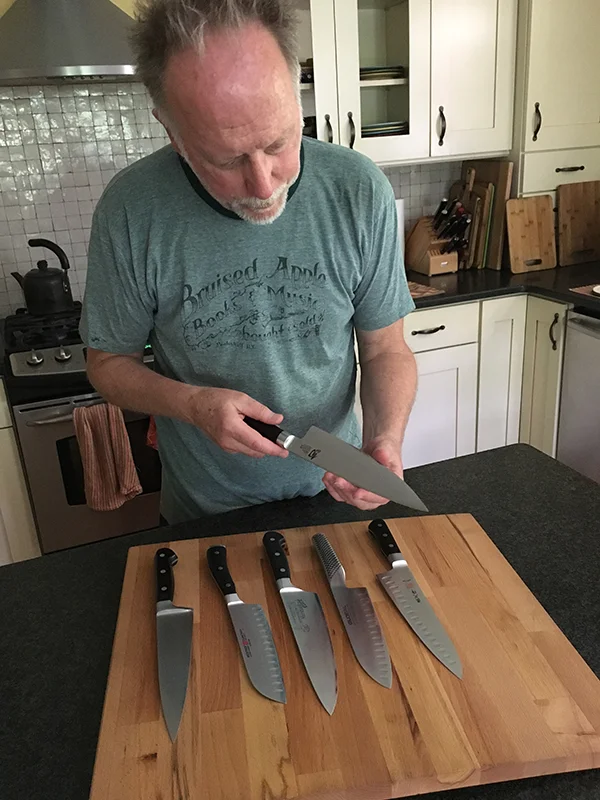
The chef knives I’m sweet on for this article range from $100 to $200—though if you monitor the ever-fluctuating prices you may grab a deal. They are by no means the top of the heap—for price tags in kitchen knifedom can get pretty steep, quickly getting into hundreds (or even thousands) of dollars. (Please read my article How to Buy a Great Chef Knife to get more backstory on how to choose the knife that’s right for you.)
If you’re concerned about moola, please remember that your best chef knives, depending on how hard you use them and how well you take care of them, can easily last 25 years or more. I’m not exaggerating. Plus, they’re the single most important tool in your entire kitchen. (What would compete, your large sauté pan?) If you dollar-cost average the price of one of the most expensive knives on this list (say, the Shun Classic for $185), over 25 years it would cost you a whopping $8 per year! So try to see the BIG picture.
Best Chef Knives Testing — Malarky
Although I own all six chef knives on this best chef knives list and have used them to chop onions, quarter cantaloupes, slice tomatoes, and more—I have not officially “tested” them. Huh?
Yep. I have declined to put these knives through a series of, supposedly, quantifiable kitchenistic tasks and use their perceived performance as a basis of rating each knife. Why? Because I don’t think it’s accurate or, in the long-run, truly useful to the consumer. Because, in the end, the main thing you’re testing is just how sharp the factory edge is. And, while it is more than nice to buy a chef knife with a razor-sharp factory edge—on average, the factory sharpitude of your new knife, even if you hone it religiously, will probably only last a year or two max. Not 25 years. Not even five.
So why make the sharpness of the factory edge the end-all criteria for whether or not a chef knife works for you? Especially if there’s another blade you love in every other way except that it doesn’t happen to be quite as out-of-the-box sharp.
No matter where you live, you can ship your favorite chef knife off to a top-notch professional sharpener and they will give you an edge sharper than most factories. There, problem solved. But other, more permanent, characteristics can’t be so easily tweaked. Like the feel of the handle. The weight. The size of the blade. The look and style of the knife. These you can’t change. . .so why not be happy with them?
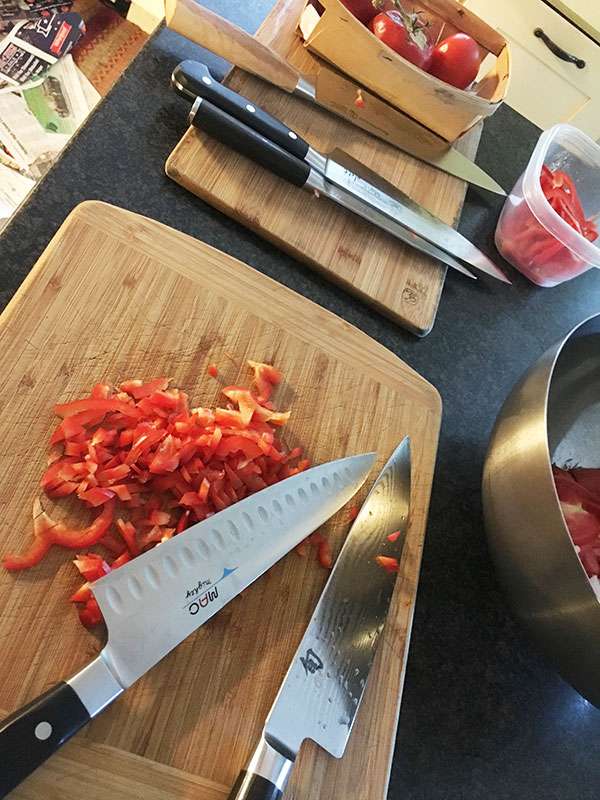
Don’t get me wrong, some kind of testing, including sharpness, can be useful. A quick perusal of Reviews of Professional Knife Sharpening Services will demonstrate I can be a manic tester. And don’t get me wrong again—you definitely want a chef knife that can take a fine edge and hold it. But in a review designed to help you choose a life-long kitchen partner (i.e. chef knife), absolute sharpitude from the factory shouldn’t be the only event, the prime criteria, for choosing one knife over another. Especially since razor sharpness can so easily be gained later on if necessary.
(Nevertheless, I do address the odds of maximum factory sharpitude near the bottom of this article under the heading Best Chef Knives Mostly Likely to Emerge from the Box Scary Sharp.)
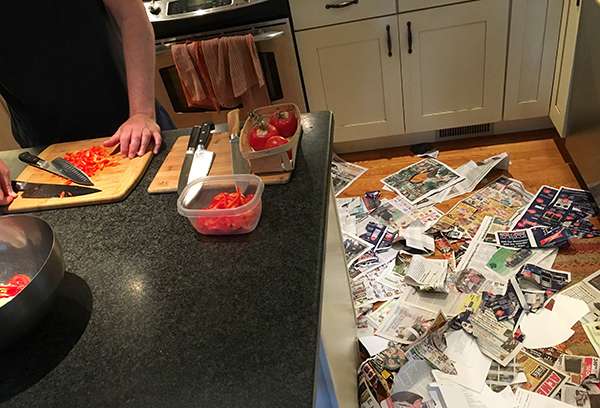
Stainless Steel vs. High-Carbon Stainless Steel vs. Carbon Steel
All of the knives I recommend are stainless steel or as current marketers love to declare, “high-carbon stainless steel.” Is there a difference? Not much. All steel has carbon and all stainless steels have very similar amounts of carbon that might vary only by .5 percent. There’s not a dramatic difference (as far as the carbon’s concerned) between stainless steel and high-carbon stainless steel. . .it’s more in the name.
On the other hand. . .there is a huge difference between “high-carbon stainless steel” and just plain “carbon steel.” Carbon steel lacks a healthy dose of chromium (10.5 to 30%)—which is the element that allows stainless steel to resist corrosion. Thus, carbon steel can rust pretty darn easy while stainless cannot. On the other, other hand. . .high-caliber carbon steel can take a finer/sharper edge and hold it for a longer time than most stainless steels.
Soooo, as in most things in life (except chocolate), there are always trade offs. . .
OK. . .off we go!
• • •
Zwilling J.A. Henckels Professional S Chef Knife, 8-inch
BUY NOW $100–160 @ Amazon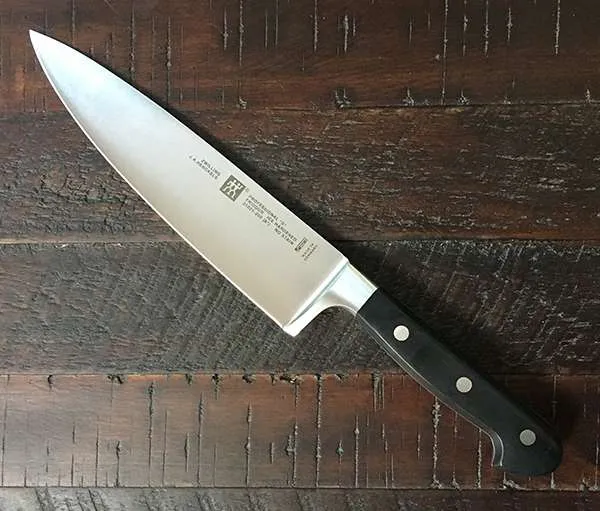
Zwilling J.A. Henckels is one of the largest knifemakers in the world and has been around since the 1700s. They produce over 24 different lines of knives (if you include Henckels Classic and others), so it’s especially important to be clear what model you’re buying.
Like most of Zwilling’s top-tier lines, the Professional S is manufactured in Solingen, Germany where their core factories are located. Zwilling/Henckels also has factories in Spain and, as a newer development, in Japan as well. It’s in Japan where they produce one of their latest creations, knives designed by Bob Kramer, the American bladesmith who has set the bar high for kitchen-knife quality.
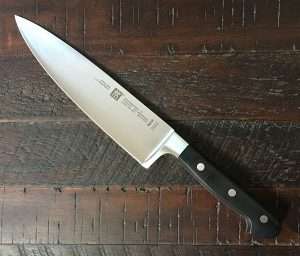
The Professional S is forged from one hunk of steel—and with a bolster, a full-tang, and a three-rivet handle, it’s as classic as it gets. Although the handle’s been made to look and feel like wood, it’s not. Wood handles are no longer the norm (although they’re making a comeback!) and most manufacturers assume customers would rather have the longevity offered by a synthetic material. (Below: the Professional S handle close-up)
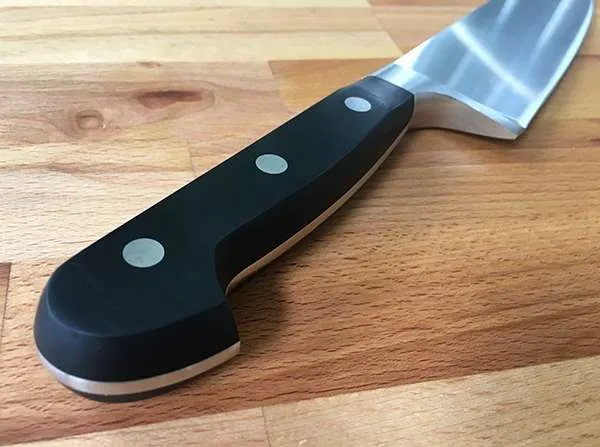
I inherited a Professional S chef knife from my Mom and it has been one of the mainstays of our kitchen. I’ve always loved the feel—nicely balanced with a little heft, but nothing that tires my hand out (for the record, I don’t spend hours prepping). I got it professionally sharpened many moons ago and with regular honing its kept it’s edge. Believe it not, it can still slice tomatoes. This is proof the steel (though by no means the hardest out there) has been properly heat-treated.
In order to be up-to-date for this review, I took a close look at a brand new Professional S to compare to my older one. No surprise, Zwilling has upgraded in the intervening years, converting the finish on the handle to matte (much hipper) and making and the blade thickness a touch thinner (to compete with the Japanese invasion). Otherwise, everything else seems unchanged—same blade shape, same handle, same great feel.
I confess, I was curious about mildly testing the factory-edge sharpitude of this new Professional S because, to the touch, it appeared quite decent. So I ran it through my newsprint magazine cutting test (see Reviews of Professional Knife Sharpening Services) which it passed with flying colors, easily slicing full half moons. While this is only one, solitary knife, it’s definitely a good sign.
The Professional S comes in two sizes, an 8-inch and 10. (There’s also a 6-inch, but that’s too small for an all-purpose blade.)
Please be aware that Zwilling/Henckels makes a very, very similar model of chef knife, the Henckels Classic, which is manufactured in Spain and goes for less than half the price of the Professional S. (To add to the confusion, it used to be called the Henckels International.) Although it’s a respectable forged knife, it’s not hewn in Soligen, Germany, does not go through the same heat treatment, and isn’t as beautifully finished. (Below: Henckels Classic chef knife—in a photo it appears identical to the Professional S.)
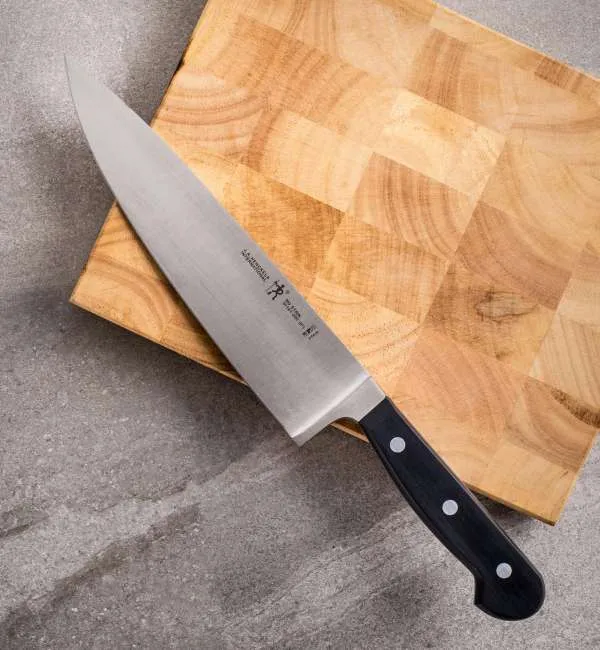
The Henckels Classic has garnered some positive press because it’s an especially good bang for the buck. It deserves it. Nevertheless, for the long-term, and if you appreciate finer finishing, I think the Professional S is a better investment. And rest assured, if you were to compare them side by side, handle them both in your hands, you would be able to tell them apart.
FEEL FACTOR | Handle girth: average / Weight: 8.75 oz / Total length: 13.25 inches
The Zwilling J.A. Henckels Professional S is the heaviest and thickest of the roster of knives in this review (it pretty much ties with the Messermeister Meridian Elite Stealth in weight)—but it’s really not all that heavy or thick. Most home cooks are accustomed to this weight and enjoy the way its gentle, gravitational pull helps them when they slice downward. But some may opt for lighter and nimbler.
The only time I’ve noticed the thickness of the blade slowing things down a tad is when doing horizontal slices into an onion (the first series of cuts out of three when dicing an onion like a pro). For the remaining, vertical, slices, it’s not much of an issue.
See my Best Chef Knives Specs chart at the end of the reviews to compare specs for all the knives. (Note: All specs listed for Zwilling/Henckels are for the latest model.)
More Options
• Zwilling/Henckels now makes the Pro line (no “S”) that sports a stripped down bolster which makes the blade easier to pinch grip as well as sharpen. The blade also has a slightly different shape—a steeper curve to the belly and a longer flat area. (See photo below.) Contrary to the Henckels Classic, the Pro is made in the same German factory as the Professional S, touts the same level of quality, and it’s price reflects it: Zwilling J.A. Henckels Pro Chef Knife, $120–160 @ Amazon / Sur la Table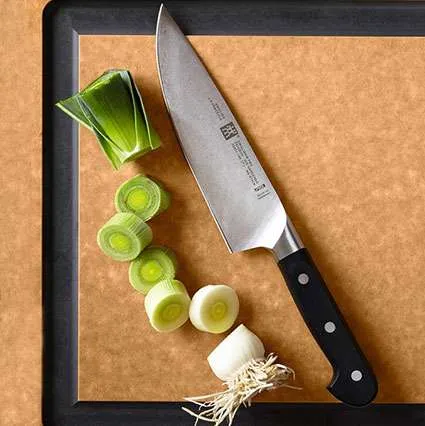 • If you’d rather have a classic-shaped blade (as in the Professional S), but like everything else about the new Pro, you can get the Pro “Traditional.” Zwilling J.A. Henckels Pro Traditional Chef Knife, $120–160 @ Sur la Table • If you prefer to buy Wusthof—which I discuss below—they make a very similar model to the Professional S: Wusthof Classic Chef Knife, $150–200 @ Amazon / Sur la Table
Wusthof Classic Ikon Santoku, 7-inch
BUY NOW $130–200 @ Sur La Table / Amazon 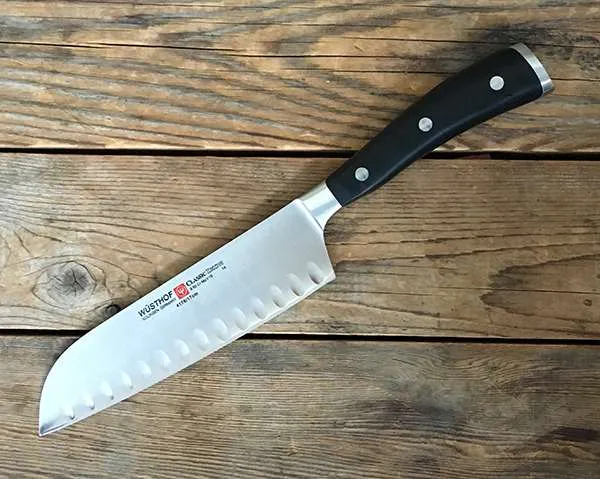
Wusthof is the other of the “Big Two” German knifemakers, and some pros swear by it over Henckels because they feel the quality is higher. Not sure if this perception is justified, but it’s probably aided by the fact Wusthof has been family-owned and run for almost 200 years. Interesting enough, both Wusthof and Henckels are manufactured in Solingen (along with dozens of other blademakers) which is one of the knife-making capitals of the world.
I recommend looking at the Wusthof Classic Ikon santoku as a contrast to a traditional chef knife because:
1) it’s a santoku, Japanese-style blade, which many home cooks prefer. It gives you the width of a longer knife without the more cumbersome length. And it’s noticeably thinner and lighter than your standard, German 8-inch chef knife. This thinness gives you less resistance when slicing through dense materials like carrots and squash. A big plus!
2) the Classic Ikon curved handle might feel better in your hands
3) it looks cool.
“Whether or not you like a bolster is up to you, it is no measure of quality. . .”
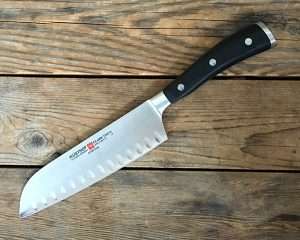
Like the Henckels chef knife above, this santoku is fully forged and has a full tang. But, unlike the Henckels, it does not host a full bolster. Whether or not you like a bolster is up to you, it’s no measure of quality—but not having one will make the knife easier to sharpen.
The Classic Ikon santoku also features a scalloped edge that is all the rage—to, theoretically, keep food from sticking. (This is most effective for only certain kinds of slicing, but it sure looks cool.) Because this model is in the Japanese-style, but made by a German knifemaker, I would call it a hybrid. (Henckels makes santokus as well.)
If you like the santoku style, but don’t care about the Ikon’s curvy handle and would like to save some cash, check out the santoku Wusthof makes in the Classic line. The feel will vary slightly (because of the different handle), but the blade itself will be exactly the same. You’re paying extra for the handle.
FEEL FACTOR | Handle girth: slim / Weight: 7 oz / Total length: 12 inches
I love using this Wusthof santoku to slice up melons, mince onion for guacamole, and to perform pretty much any other kitchen-knifeian task. The only time I feel it’s compact size gets slightly overwhelmed is when fine-chopping large quantities of zucchini, carrots, and other veggies.
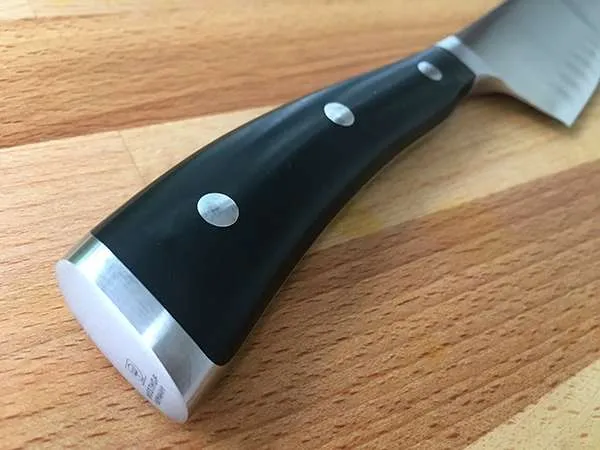
Though the curved handle is a touch slimmer than your average chef knife (aka the Henckels above), it’s ergonomically satisfying. It’s also lighter—but definitely doesn’t feel like a toy. Plus, I must admit, I don’t mind the oohs and aahs I get when wielding it in front of guests. (So shallow, I know.)
Although I have had this knife professionally sharpened, I distinctly remember it being very sharp straight from the factory. I acquired three Wusthof blades around the same time—a santoku, a nakiri, and a chef knife—and the two Japanese hybrids were noticeably sharper than the chef knife. All three had been sharpened using Wusthof’s patented PEtec sharpening system (using laser guides for accuracy and consistency). But I think because the santoku and nakiri are thinner blades, the PEtec system gave them finer/sharper edges. No complaints here!
Don’t forget to peruse my Best Chef Knives Specs chart at the end of the reviews to compare specs.
If you want to learn more about all things Wusthofian, make sure to visit Wusthof Knives—a Buyer’s Guide.
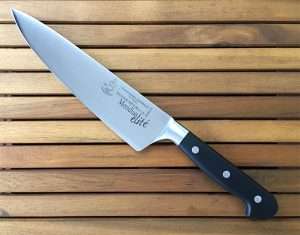
Messermeister Meridian Elite Stealth Chef Knife, 8-inch
BUY NOW $125–150 @ Amazon / 9-inch, $130–170 @ Amazon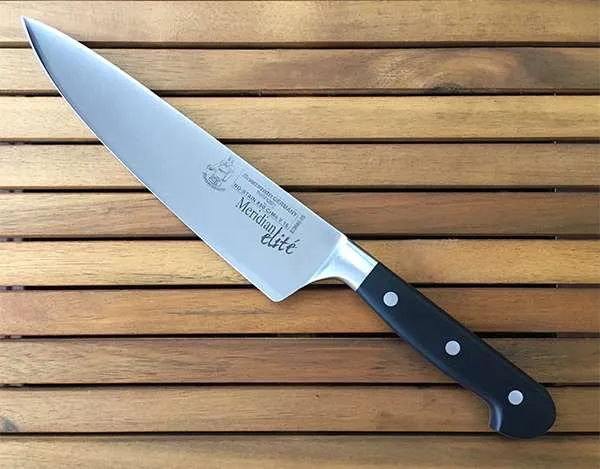
Messermeister knives, like the name sounds, are rooted in Germany—manufactured in the very same German town (Solingen) as the preceding knives from the Big Two. While Messermeister is not as familiar a name as Henckels and Wusthof, they’re no less revered for their quality. As a matter of fact, their forging process (Meridian Elite is hot-drop hammer forged) is closer to the older style of doing things than either Henckels or Wusthof.
The Meridian Elite Stealth makes my Best Chef Knives list for a couple of reasons:
1) it’s highly recommended by Chad Ward in his book An Edge in the Kitchen as being super-sharp. It comes from the factory with a highly polished edge that Ward claims is superior to any of the “big-name knife brands” and will hold it for a substantial amount of time
2) it has a partial bolster which makes it easier to sharpen (and is a nod to Japanese knives).
Messermeister has been a trailblazer in German kitchenknifedom. They were the first to produce a forged chef knife without a full bolster (yes, before Wusthof and Henckels), and. . .the first to sharpen their blades to a sassy 15-degree angle. (The old German standard being 20-22 degrees.)
“The blade on a Stealth chef knife is about 25 percent thinner and (thus) 10 percent lighter…”
They’re also the first to manufacture an alternate version of their premium forged lines which they name “stealth.” The blade on a Stealth chef knife is about 25 percent thinner and (thus) 10 percent lighter than the traditional model. Less resistance while slicing and less weight to fatigue your arm. A home cook might not notice much difference. But a pro, wielding the blade eight hours a day, surely should. Cool idea, to offer the customer a choice!
I definitely prefer the Stealth version of the Meridian Elite and that is what I recommend. I found the thickness and weight of the original a bit unwieldy. Nonetheless, some cooks love the feel of a weighty blade and may not mind the thickness. More power to them—they can acquire the original. (For the record, the original Meridian Elite 8-inch is a little over an ounce heavier and almost a millimeter thicker than the Stealth.)
FEEL FACTOR | Handle girth: average to slim / Weight: 8.38 oz / Total length: 13.5 inches
As you would assume, this puppy feels very similar to my beloved Zwilling/Henckels Professional S except that the Messermeister’s handle happens to be slimmer. (This is true for both the Original and the Stealth.) So if you enjoy the feel of a traditional German chef knife, but wouldn’t mind a more svelte handle, you might prefer Messermeister over Henckels. I’m on the fence myself—it depends on the day.
(Below: Zwilling/Henckels, Wusthof, and Messermeister—the Messermeister sports the widest blade and, along with the Wusthof, has a half-bolster for easier sharpening.)
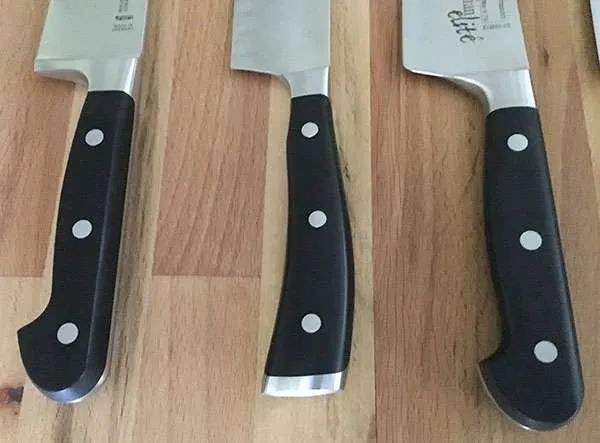
Along with the slender handle, the Meridian Elite Stealth’s blade is ever-so-slightly thinner (than the Professional S) and ever-so-slightly wider at the heel. Plus, the overall weight is lighter by almost half an ounce. So what do these subtle differences mean? 1) You’re getting slightly less resistance. I’ve already discussed this, so, by now, you should know what that means. 2) More chopping dominion—the spine stays above the food. 3) More mobility, less clunkiness. These are all positives in my book and warrant giving the Messermeister serious consideration.
Performance-wise, the Messermeister has put me in a pickle and is one of the most glaring reasons I refuse to judge these six recommended knives strictly by their factory edges. Let me explain. . .
I’ve acquired three different Messermeister forged chef knives: two 8-inch chefs—the original Meridian Elite and the Stealth; plus, a 9-inch Oliva Stealth (see the box below). All three blades are of the same caliber—the Oliva distinguishing itself with an olivewood handle.
“Knife Nerds!! See my Best Chef Knives Specs at the end of the reviews to compare and contrast.”
Out-the-box, the Oliva sliced a tomato effortlessly while with other two had problems. Because the cutting edges (on all of the Messermeisters) were thin and finely ground, and the blades beautifully polished, and, good old Chad Ward was so enamored of them, I figured the Meridian Elites might still have possibilities. So I tried steeling them with a ceramic hone (only half-a-dozen swipes per side) which probably put what’s called a miro-bevel on end of the edge and allowed them to slice through ‘maters just like the Oliva. Problem solved.
Is this what a consumer should be prepared to do? No, of course not. But if a knife or two slips by a high-grade knifemaker’s quality control, it doesn’t necessarily mean that manufacturer’s knife line is categorically inferior to that of another manufacturer. It all depends. The most important thing for the consumer to do is get as educated as possible and not judge solely by a single knife’s sharpitude. Especially if there are other aspects of a knife’s design that make them sweaty (yeah, I know, time to visit a therapist).
Messermeister Oliva Elite Stealth, 9-inch
BUY NOW $180–220 @ Amazon / 8-inch, $150–190 @ Amazon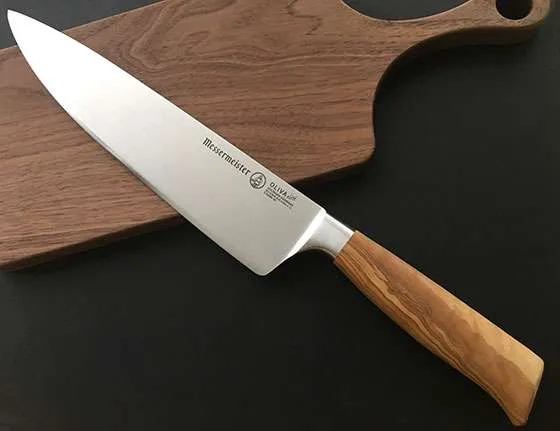
Wow, am I a sucker for the olivewood handle. I was so taken by its beauty, the earthy feel of the unfinished wood, and the comfort of its curviness, that I almost swapped out the Meridian Elite in this list for the Oliva. Actually. . .I would have—if I hadn’t already taken all the group photos.
As for the rest of the knife—forged stainless-steel blade, high-grade finishing—Messermeister quality is all present and accounted for.
FEEL FACTOR: Handle girth: average to chunky / Weight: 7.75 oz / Total length: 14.75 inches / Width at heel: 2 inches / Spine thickness: 2.7 mm
As you might guess, the handle on the Oliva not only looks different, but feels quite different from the Meridian. It’s bigger, it’s chunkier, it’s more to hang onto. As a matter of fact, it sort of ties with the Shun as chunkiest handle in this list of knives. I absolutely love it. . .but I probably lean towards heftier handles. Although, in general, I’m not very fussy and I find my hand easily adapts to the shape of whatever it’s holding (as long as it’s sharp!).
Another unexpected benefit of the Oliva Elite Stealth, 9-inch (the only size Oliva I’ve sampled so far) is that, even though it’s long, it’s light. At 7.75 ounces, it weighs even less than the 8-inch Meridian Elite Stealth and Henckels Pro S. This is mainly due to the fact that the Oliva is constructed with a partial-tang—i.e. the steel from the blade does not run all the way through the handle to the end.
Full-tang used to be one of the must-haves in a quality chef knife, but those days are long gone. We’re not butchering buffalo haunches here. So if you’re in the market for a longer chef knife, but are concerned about arm fatigue, or simply have an aversion to weighty cutlery, the Oliva 9-inch is an excellent option.
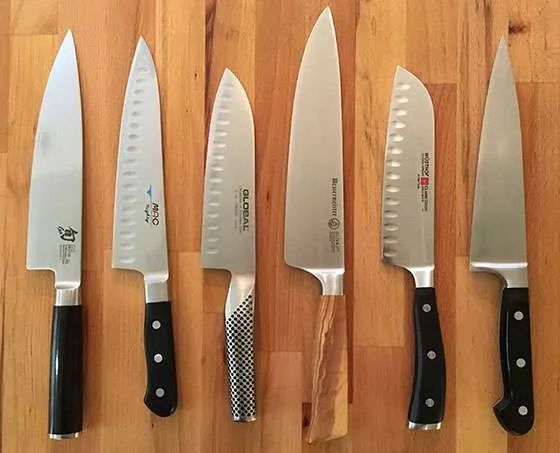
I’ve only got two quibbles:
1) Balance: The balance on the 9-inch is tipsy toward the blade. I rarely, if ever, notice. But if you’re finicky about balance, then it might bug you. For what it’s worth, the 8-inch Oliva should be more evenly balanced because there’s an inch less steel in the blade to tip it forward.
2) Finishing: The olivewood handle, from the factory, is virtually unsealed. So you must make a habit of rubbing it with mineral oil to protect it. You can use the same exact oil you should be using on your wooden cutting boards.
The Oliva Elite only comes in Stealth.
OK, I’ve touched on this already, but let me spell it out more clearly: The main differences between a German-made and Japanese-made chef knife are: 1) the thinness of the blade, and 2) the steel they’re made of. As a general rule, German knives are thicker than Japanese and hewn from steel that is not quite as hard. This is a design choice, not a manufacturing defect.
Let’s talk about thin. A thin Japanese blade feels a) lighter in your palm and b) glides more easily through food—especially denser stuff like potatoes, pork loin, etc. While you may grow to appreciate the smoother slicing, it’s not the sort of lightening-bolt event that’s going to make you jump up and down crying, “Eureka, eureka!” It’s subtle. On the other hand. . .the lack of weightiness will immediately make an impression on you. And it will take you a while to totally acclimate to it. That’s OK, it’s worth getting used to.
In addition—a thinner blade makes the knife a bit more delicate, easier to permanently bend or (believe it or not) break through prying or torquing.
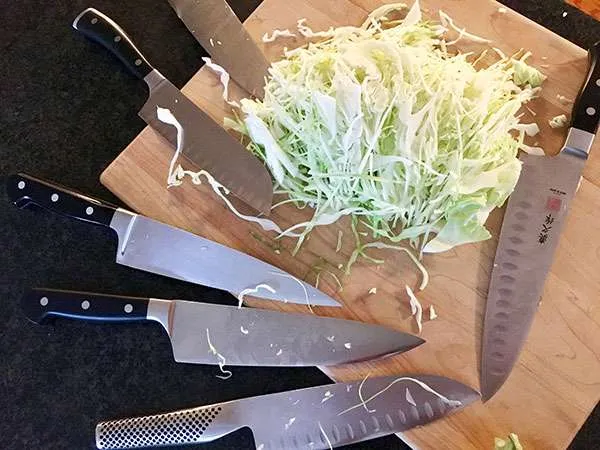
Let’s talk about steel. Steel is a monster topic, but the Cliff Notes version is that the make-up of steel and the way it’s heat-treated can affect the way that steel behaves considerably. The steel in a German knife will tend to be tough and able to withstand abuse, but won’t be as hard as Japanese steel. Thus, the cutting edge will wear down more quickly and need to be sharpened more often. Japanese steel will tend to take a finer edge and hold it longer. But because its hardness also makes it brittle, it’s more likely to chip or crack under stress (i.e. mistreatment). It’s simply not as pliant or forgiving. You must take greater care.
Neither steel is perfect. So it’s up to the cook to understand what kind of knives they need in their kitchen and be aware of their strengths and weaknesses. For what it’s worth, I use both German and Japanese chef knives and rarely am I conscious of specifically choosing one over the other. But when I am conscious of it, there’s a very good reason.
What does all this mean in the real world?
- If you happen to knock a Shun chef knife (Japanese-made) off the counter on to a ceramic tile floor, you’ll be lucky if you don’t break a tip. Seriously.
- If you can’t be bothered to regularly steel/hone your knives, a Japanese chef knife will probably stay sharper for a longer time. (But if you hone regularly, you won’t notice as much a difference.)
- If you power through a chicken joint with a German knife, you will temporarily dull the edge, but probably not hurt it. But if you try the same trick with a Japanese blade (especially the last two in this list), you will seriously risk cracking or chipping an edge.
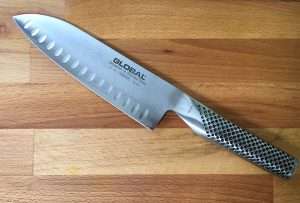
Global Classic Santoku, 7-inch (G-80 or G-48)
BUY NOW $90–130 @ Amazon / Sur La Table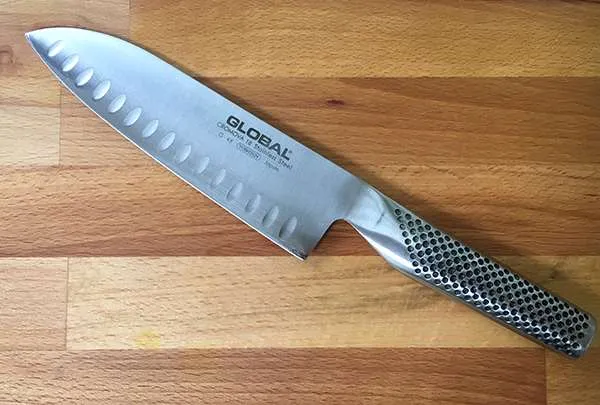
Global revolutionized the kitchen-knife world in the 1980s by creating a series of high-performance knives that were on the cutting edge of fashion (forgive the pun), yet still affordable. Like traditional Japanese knives, they’re extremely light with a thin, razor-sharp edge. Yet in overall shape and design, they often owe as much to Western tradition as Japanese. That’s why I call them Japanese hybrids in that they graft one tradition of knifemaking onto another.
Most of Global’s knives are not forged, but made of a high-quality stainless steel that has been tempered and heat treated to new levels of sophistication. Global uses their own proprietary steel which they dub Chromova 18. Although its composition is very similar to the steel used in the German-made knives in this list (X50CrMoV15), that doesn’t mean it performs identically. There’s a lot more to steel than just a list of condiments.
If you’re in a hurry. . .scroll down to Quick Takes and Pros and Cons.
If you review my Best Chef Knives Specs chart, you’ll see that the G-48 santoku is the thinnest and lightest of my recommended knives. This hints at why it’s so good at slicing (and doing everything else, for that matter) and why many professionals, like the late Anthony Bourdain, have a thing for the Global brand. It also doesn’t hurt that Global knives have long had a reputation of coming from the factory uber-sharp.
While the shape of the blade on the G-48 (G-80) is similar to the Wusthof santoku, the balance and feel is quite different. To say nothing of the styling. No major knife brand stands out as so stunningly modern. Also—although it appears the knife is made of a single piece of steel, it’s not. It’s actually three—the blade, and two sides of the handle which have all been welded together. (Interesting detail: Global injects the perfect amount of sand into the hollow handle to make it balance correctly.)
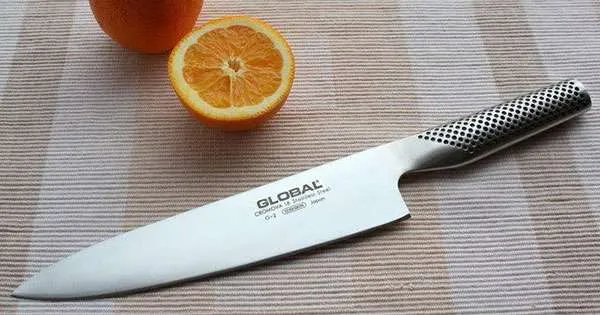
If you prefer a more traditional, chef-knife shape, but are still attracted to Global’s modern design, you should definitely audition the G-2 chef’s (shown above). The manufacturing process is identical to the G-48 santoku and it’s probably one of Global’s most popular knives. Or, if you’re curious about Global’s newest creations, I’d recommend checking out the SAI-01. The SAI’s sandwiched-steel construction departs, slightly, from that of the Classic collection, but the quality is just as high (or higher). And the textured, hammered-steel surface breaks new ground for Global.
FEEL FACTOR | Handle girth: slim / Weight: 6 oz / Total length: 11.75 inches
Even though it looks like it might be slippery, the pebbled handle grips quite well. It’s been specifically designed to hug your fingers. I don’t like slippery knives and this is not one of them.
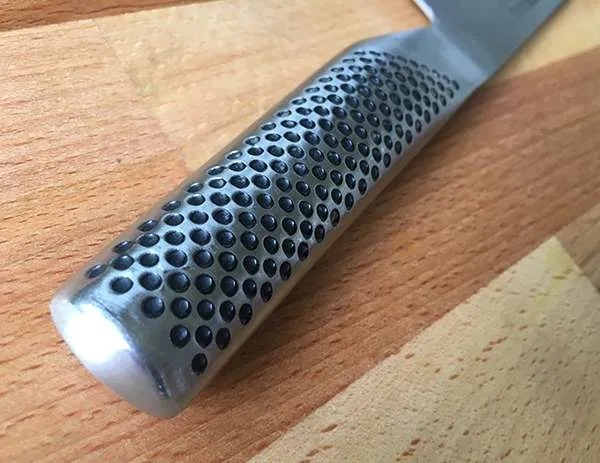
I’ve owned this santoku for over a decade and have had it sharpened only once by my favorite professional sharpener, Bozman [Seattle] Knife Sharpening. That would attest to the fact that Global’s steel holds its edge very well indeed. I’m embarrassed to admit I treasure it’s sharpitude so much I resist doing much chopping with it, but save it mainly for slicing. Which it does amazingly! (Crazy, I know.)
Again as with the Wusthof santoku (or any knife with less than an 8-inch blade), if you chop up large quantities of vegetables on a regular basis, you will feel a bit overwhelmed. It will cost you more time. That is the main liability of a slightly shorter blade. But. . .if you perform this kind of prep work, say, only once a month, I wouldn’t worry about it. The Global santoku can carry the day—maybe a touch easier than the Wusthof.
Watch my video, How to Chop an Onion Like a Sous Chef, to see the G-48 in action making quick work of the kitchen’s favorite root vegetable!
KitchenKnifeGuru eBook—
Kitchen Knife Basics
For all you eBook junkies who would rather snuggle up with with an iPad than click and scroll on a computer. Kitchen Knife Basics ($7.95) has got all the core material from the KitchenKnifeGuru website, but in an easy-to-read format that only an eBook can offer. You’ll learn about the most common edge styles for kitchen knives, what a hone (or steel) is and exactly how to use it, how to find and choose a quality sharpening service that’s not expensive—and much much more. You can even download a sample if you just want to get a taste!
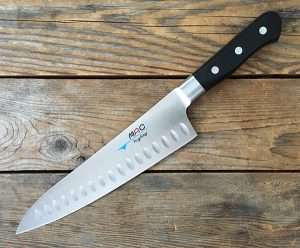
MAC MTH-80 – Professional Series Chef Knife with Dimples, 8-inch
BUY NOW $120–145 @ Amazon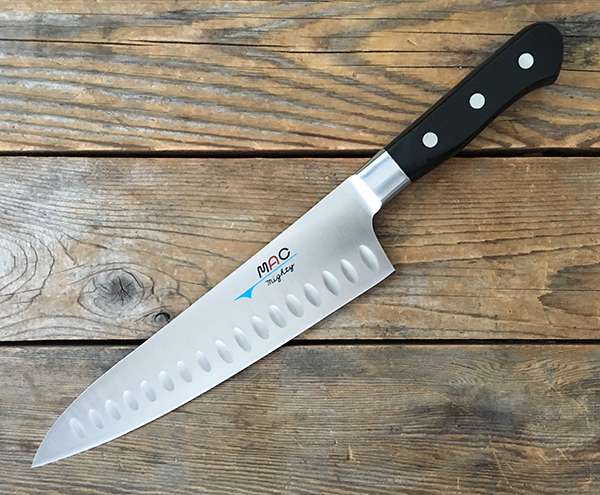
MAC knives are one of the best kept secrets of the consumer kitchen knife market. Professionals rave about them with celeb chefs like Thomas Keller and the late Charlie Trotter unabashedly endorsing them as the ultimate cutting machine. But ask your average home gourmet, and odds are they’ve never heard of them. That has changed some in the past few years due to internet marketing, but MAC is still under the radar.
Japanese designed and manufactured, like Global, they’re a new breed of kitchen knife, a hybrid—that incorporates the harder and thinner Japanese steel with a Western-shaped blade. They’re not as stylish as Global, but probably even sharper. And (like Global) they’re also not forged, but highly machined.
The MTH-80 Professional is the workhorse of MAC’s various product lines and I’m guessing it’s the most popular because it offers the maximum sharpitude for your dollar. Plus, the welded-on bolster creates an unusual combination of super-thin blade with added weight that keeps it balanced in your hand more like a German-style knife. According to Gourmet Magazine, a MAC MTH-80 compared to your average chef knife is “the difference between a minivan and race car.” Care to take one out for a spin?
(Note: Please be careful not to confuse the MTH-80 Professional with the TH-80 – Chef Series 8-Inch Chef Knife with Dimples, a lower-level model that goes for $40 or more less.)
FEEL FACTOR | Handle girth: slim / Weight: 7 oz / Total length: 12.75 inches
The MTH-80’s handle is on the slim side. For your average gal, and guys like me with smaller hands, this might be perfect. But if your chefing hand is large-ish and you want the handle on your chef knife to fill it, the MAC might, literally, leave you empty handed. (Below: MAC and Shun handles—Best Chef Knife with the smallest grip area next to the largest.)
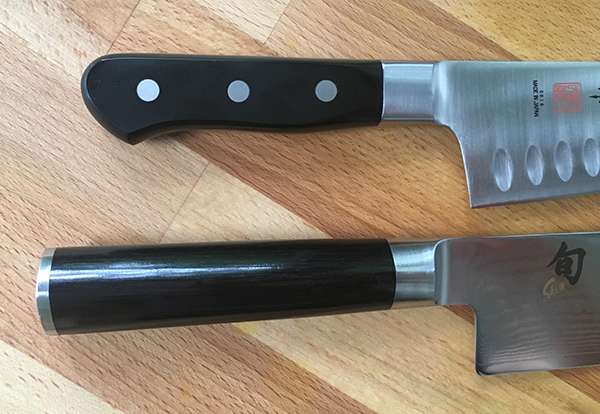
Also: the shape of the blade on a MAC MTH-80 differs from your typical Western chef knife—it’s narrower at the tip, then gradually widens out to the heel. It’s not as consistently wide as its German cousins, closer to what the Japanese call a gyoto. The narrowness makes it nimble for slicing, while the width is still there where you need it most, close to the handle. But if you are accustomed to a more evenly broad blade, you’re going to need to make adjustments.
I don’t want to harp on this, but it’s worth noting: Of all the knives in this list, the MAC is the most guaranteed to come from the factory with a blistering sharp edge and keep it. Yes, MAC’s manufacturing formula helps—but it’s also their rigorous quality control.
MAC’s head of marketing for the U.S. told me that in recent holiday seasons, they can barely keep up with orders. Why? Because they will not allow customer demand to put undo pressure on quality. They’d rather maintain the brand’s integrity, than sell more knives. Music to my ears. . .and not a strain you hear much in this age of instantaneous factory to market.
For more recommendations on Japanese chef knives, make sure to visit: Best Japanese Chef Knives — Six Recommendations.
Final note: From the MAC warranty materials: “Do not cut on hard items (bones, frozen foods, shells, squashes, cheeses, chocolate).” Do you need any more proof that you must be mindful with a Japanese blade—this one in particular? Revel in the sharposity, but treat it like a lady.
(And if you’re ready to compare fine points between knives, don’t forget my Best Chef Knives Specs chart at the end of the reviews.)
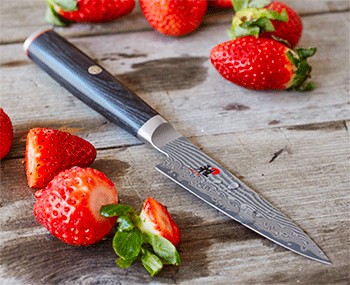
Miyabi Kaizen II Paring Knife, 3.5-inch
BUY NOW @ Sur La Table
Yeah, I know, this is supposed to be about chef knives. But this is one gorgeous paring knife that will skin a peach like there’s no tomorrow. Damascus-patterned steel wrapped around the latest hi-tech core that will take a fine edge and keep it. I bought one for myself a year ago and I still get a secret little thrill every time I slice up an apple. It’s light, but stays in your hand because the handle has some girth.
Miyabi, as the name suggests, is a true-blue Japanese knife manufacturer acquired by Henckels in 2004. The majority of Miyabi knives available in the U.S. are Japanese/German hybrids—thin Japanese blades designed in the shapes/functions Westerners are accustomed to (chef knife, paring, boning, etc).
Of course, if what you really need is a chef knife, then scope out the Miyabi Kaizen II which is often on sale. The Miyabi brand exudes so much quality and style that soon I’ll need to add it to the list as Recommendation #7.
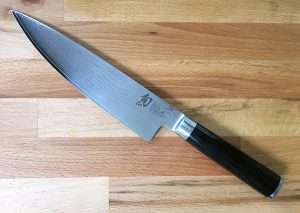
Shun Classic Chef Knife, 8-inch
BUY NOW $130–185 @ Amazon / Sur La Table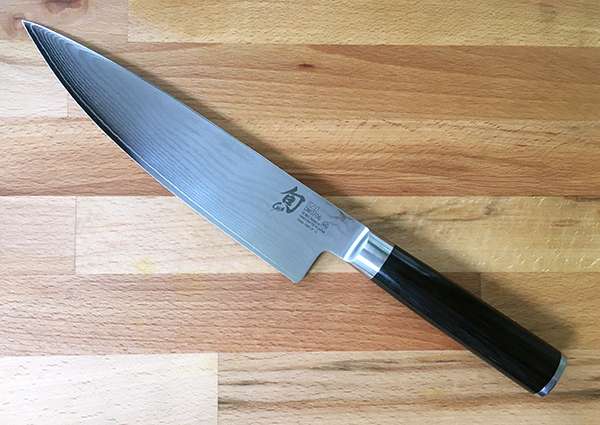
Shun, along with Global, is one of the most popular and well-known Japanese brands in the U.S. of “A.” It’s no wonder their flagship line, Shun Classic, is very attractive and very sharp. They’re manufactured in Seki City, Japan, which, along with Solingen, is another knife-making capital.
Don’t let the beautiful Damascus design on the blade fool you—it’s much more than a pretty face. Sandwiched between 32 layers of swirly-patterned softer steel (16 layers per side) lies a slim, hard core that creates the edge. At Rockwell 61, it’s harder than all the knives on this list. Which gives it the ability to hold a 16-degree edge for a very long time.
The sandwiched construction—derived from samurai swords—has a dual purpose. First, and foremost, it protects the hard but brittle core and allows the knife to flex without cracking or breaking. Second, the 16 layers on each side host the intricate Damascus pattern that embellishes the blade.
DAMASCUS STEEL Traditionally, “Damascus steel” referred to a centuries-old technique (from the Middle East) of melding layers and layers of metal, not only to decorate, but to forge incredible strength, flexibility, and sharpitude into a sword. It could empower you with the ability to slice your enemy’s saber in two. . .that kind of thing. This Damascus technique was, supposedly, lost. As of late, the term Damascus has been more widely used to describe a patterned visual effect created with very thin layers of steel. More style than structure. But the legend of Damascus’s cutting power still lives on and there are master bladesmiths who feel they are rediscovering it.
I must admit when I first unpacked my new Shun 6-inch chef knife a few years back, I was stunned at how light it was. For someone accustomed to weightier German blades, the lightness felt almost chintzy. Silly me. Over time, I’ve now come to fully appreciate the way the lean, sleek blade can slice through denser foods with less resistance than my thicker German knives. Don’t get me wrong, I’m not ready to abandon ship—but it’s great to have Shun as an option.
FEEL FACTOR | Handle girth: average to chunky / Weight: 7.38 oz / Total length: 13.5 inches
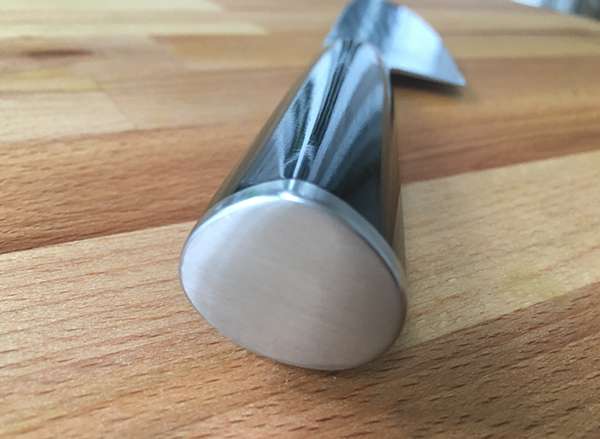
Another reason the Shun Classic is on this Best Chef Knives list is its babelicious Pakkawood handle. Pakkawood is a man-made laminate, similar in construction to plywood, except that it’s many more layers sealed under super-high pressure with a resin. It’s easy to care for, highly water resistant, and just like natural wood, no two handles are identical.
Along with it’s beauty, the shape of the Shun handle, derived from traditional Japanese blades, reads distinctive to Westerners. The rounder, D-shaped contour fits certain cook’s hands better than those of other knives. So, if a typical Western-style knife handle has never felt comfy enough, here’s another way to go. (Below: Shun Classic chef knife handle close-up)
Of the three Japanese-made blades, the Shun is the largest blade in total square inches. If you look at the “Width at Heel” number on my Best Chef Knives Specs chart, it won’t be evident. But if you combine the Shun’s width with it’s actual blade length (longest of all the knives), you can begin to see just how sumptuous the blade is.
What does this mean in practical terms? For one thing: If you chop a lot of veggies in your kitchen, the Shun’s spine will ride hide and not get lost in the mound of choppings. This will hold true for the Henckels and Messermeister as well who take up similar amounts of real estate. And, if instead of the Wusthof santoku, you opted for one of Wusthof’s standard chef knives, it would hold true for it as well. These are broad, high-riding knives which allow for bountiful scooping (of those mounds of chopped vegetables) into soup pots. So if that’s your schtick—put these knives at the top of your list.
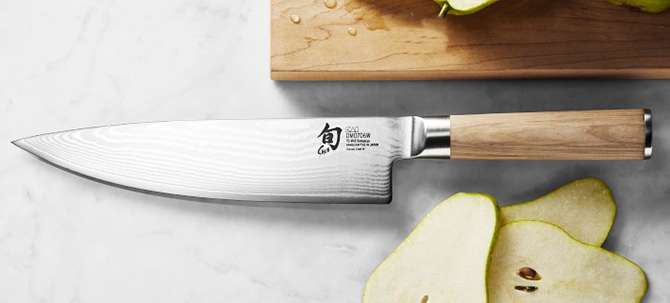
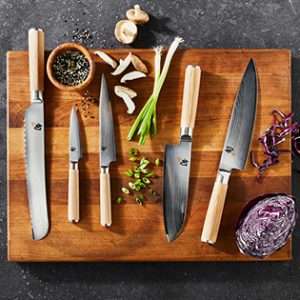
Shun has a number of other knife lines worth looking into (Premier, Dual Core, Kanso) which tend to go up in price from here. They also do, what I call, “spin-offs”—which keep the same basic blade and design, but simply swap out the handle. One of their latest is the Classic Blonde—the same exact knife (as the Shun Classic), but with a pale Pakkawood finish for the handle (see above).
Want to see to the Shun Classic chef knife in motion? Watch How to Cut a Pineapple Like a Pro where KitchenKnifeGuru wields a six-incher on an innocent pineapple!
Dive deeper into other Shun knife lines (which are all high-quality) and visit Shun Knives: a Buyer’s Guide.
Visual Comparison of Chef Knives Only
Notice how the MAC’s handle and blade shape stand out from the rest.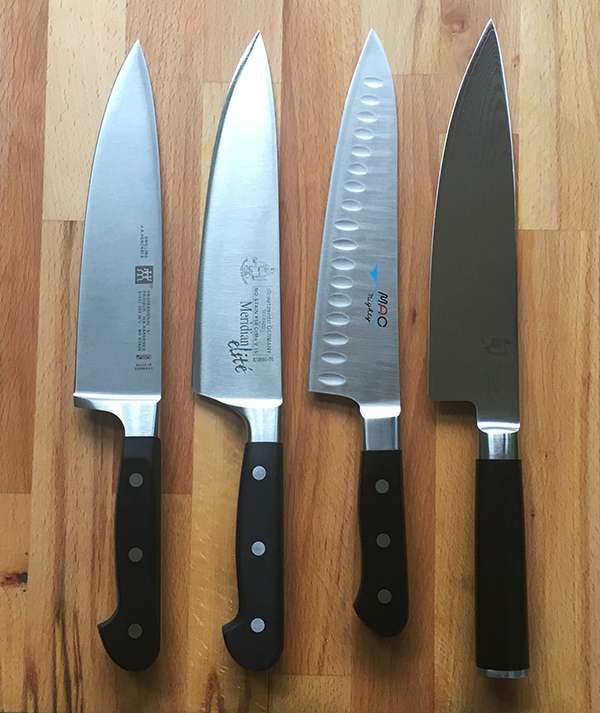
Overall Length
Left to right from longest to shortest in overall length.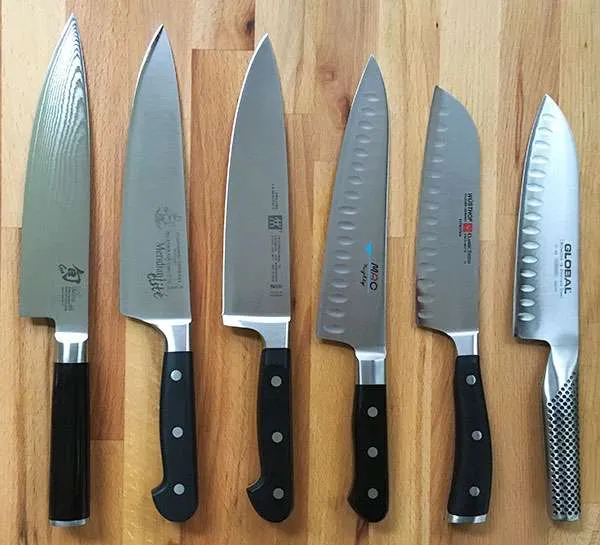
Width at Heel
The knife with the narrowest width at heel (Wusthof) next to the widest (Messermeister).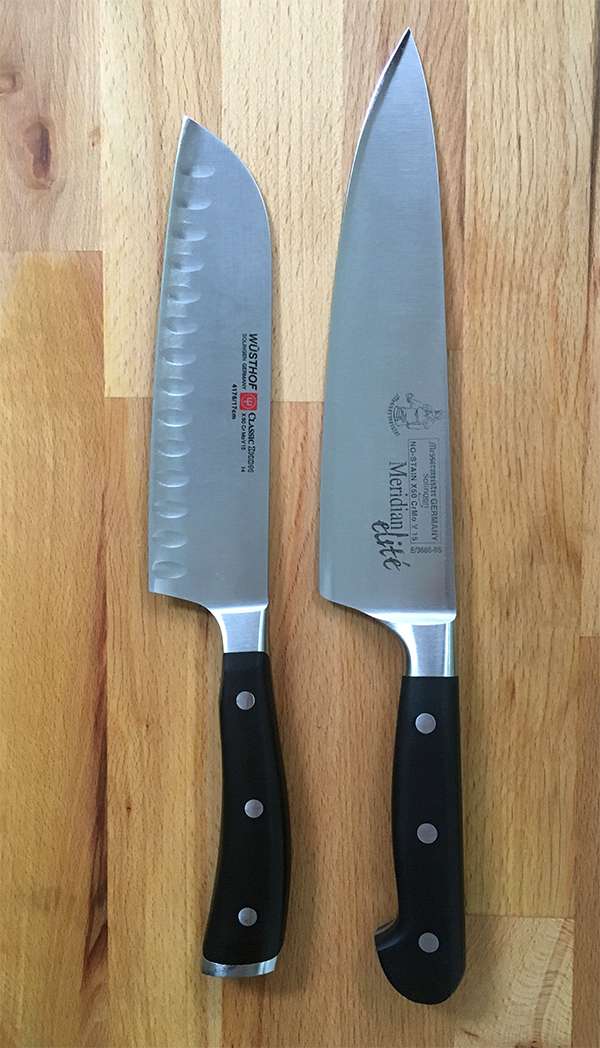
Best Chef Knives Mostly Likely to Emerge from the Box Scary Sharp
OK, I still can’t resist giving you some kind of broad roadmap regarding the cutting performance of these recommended knives out-of-the-box. (You know you want it, don’t you?) So lets make a prioritized list.
The data for this list comes from informally testing the factory edges of brand-new knives, as well as professionally-sharpened edges of used knives, on 1) ripe greenhouse tomatoes, 2) news print, and 3) other veggies and fruits (including melons, onions, carrots, etc.). Plus, 4) using the knives in various everyday kitchen-knife tasks, 5) understanding their construction and the make-up of their steel, and 6) gathering opinions through the kitchen-knife grapevine. (Below: Best Chef Knives onion-cutting tests)
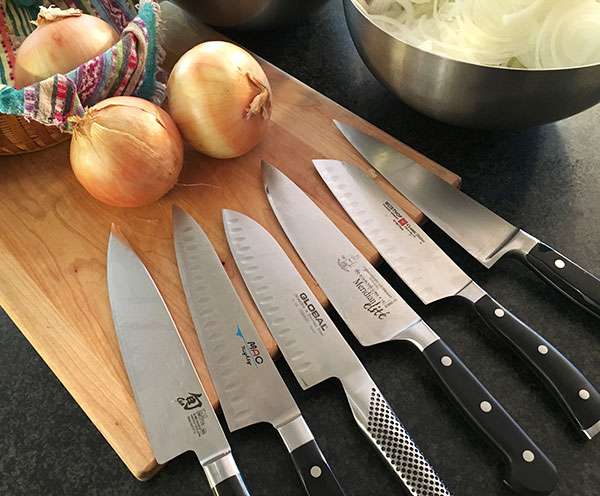
The knives grouped in twos are too close to call. The biggest noticeable difference in probability of factory-edge sharpitude should be between the three main groups.
1) MAC MTH-80 – Professional Series Chef Knife
2) Global Santoku (G-48)
—————————
3) Shun Classic Chef Knife
4) Wusthof Classic Ikon Santoku
—————————
5) Zwilling J.A. Henckels Professional S Chef Knife
6) Messermeister Meridian Elite Stealth Chef Knife
Just remember: No matter what knife you buy—after it has been used for a year or two, and then sharpened by a quality professional sharpening service—it’s cutting performance will be very very close to every other knife on this list. What matters most in the long run is high-caliber sharpening followed by zero abuse and regular honing. These will guarantee kitchen-knife nirvana. Not the ultimate chef knife. . .
• • •
Six up, six down! As you can see, there are a lot of wonderful knives out there. Hopefully this short list of best chef knives has given you a taste of the possibilities. Remember, stay with quality brands—there’s no free lunch—and stay with what feels and works best for you. It’s your body. It’s your kitchen.
And don’t forget the KitchenKnifeGuru.com motto: “Have fun in the kitchen!”
331 Responses
I have been a professional chef for almost 20 years from every place to small restaurants to the Ritz Carlton to Norwegian Cruise Lines, and I tend to lean towards the Japanese makers over the European. Being the owner of at least 50 different knives, I can provide at least a small amount of insight on the subject. While I do own several from Shun (Classic, Edo, and Blue Steel), and they are excellent, I would recommend to those of you who might be in the market to splurge ($150 – $400) to look at the Misono UX10, Blazen Ryusen, Akifusa, Kasumi, Honesuke, and Moritaka lines.
But the knives I would recommend to anyone looking to spend less than $100 for a workhorse line of knives that perform far above their price point is the Tojiro DP series made from VG10 steel. I absolutely love these knives and have seen them sharpened enough as to be able to split a human hair with no downward force applied. Obvious this involves aftermarket sharpening by an expert, but the factory edge is quite outstanding for the price.
Hey PJ, thanks for your comments! We much appreciate hearing what you have garnered from experience regarding kitchen knives. It’s a big beautiful Japanese-knife world isn’t it? The main reason I tend not to recommend higher-end Japanese knives on KKG is that it’s my sense the average home cook will not be able to maintain and care for them properly and end up chipping them, etc. The prices can also be a barrier.
Not so for the Tojiro DP series though! Thanks much for the recommendation which is at the right price point and sounds like a wickedly sharp kitchen tool. Note to readers: the VG10 steel is the same steel that Shun uses for their Classic series.
For those interested in shopping, here’s an Amazon link:
Tojiro DP Gyutou – 8.2″ (21cm)
I’d only mention one caveat regarding Tojiro: one Amazon buyer found their knife had a noticeable and annoying flaw in the blade which should have been caught in the factory by quality control. So, shoppers, please be prepared to check your knife over thoroughly before making it your own.
Cook on, cook on. . .KKG.
Hi KKG,
First off, thank you for the highly informative instructional pieces/buyer’s guides. I have to say that the depth of your interest and the level of background information/theory you provide fills me with far more confidence in your views than those of any other online resource I have accessed.
I am buying my first, serious, chef knife and will likely make some mistakes caring for and using it. Therefore, I’ve decided to go with the Tojiro DP knife as a happy medium between the effective-but-utilitarian Victorinox and one of the six, more expensive, knives you recommend.
Two questions: First, do you think this choice makes sense and, second, would this count as one of the hybrid-style Japanese knives I could hone as usual with a ceramic rod?
Thanks again for the hard work!
Nik
Great strategy, Nik, I approve! The Tojiro DP Gyuto (210mm) is an excellent entry-level Japanese blade. I assume you’ve read my observations and only caveat in the comment above yours. I’d much rather work with a Tojiro than a Victorinox (I have a hard time with the plastic handle). And the Tojiro should come from the factory super sharp and feel more like a “real” knife.
RE honing: Yes, Tojiro is a hybrid and you can definitely use a ceramic hone on it. Because the HRC is 60, a standard steel hone might cause it damage.
Have fun cooking!
Best, KKG
Hi there — I launched my own brand of high-end Japanese chef knives in November 2013 and thought you guys might like to see them. They’re still not that well known and only made in small quantities.
Personally, I think they’re the best knives in the world — but I would say that, wouldn’t I? Fortunately, some of the UK’s best chefs agree with me. Please have a look at the TOG Knives website and especially our “chef testimonials” section which is new.
http://www.togknives.com/chef-testimonials
Obviously, I’m a supplier, so I hope you don’t mind me chipping in. Thank you very much!
Rob Beagley-Brown
Hi Robert,
Thanks for exposing myself and the KKG clan to your new line of knives. They look promising and your list of testimonials definitely perk my interest!
I would take issue with some info on your “Tech Specs” page though—where you say the Rockwell Hardness of 58-60 is “harder than most knives and typical of knives from Seki.” I think you mean to say that HRC 58-60 is harder than most German knives. I’m sure you’re aware the majority of Japanese knives, including knives from Seki, are hardened to HRC 60 and harder. For example, Shun hardens their knives from HRC 60 to 62. For that matter, Wusthof hardens their knives to HRC 58 which is on the bottom end of your hardening range and they make a lot of knives! I think it would be more accurate, and less problematic, to simply tell us the HRC and leave it at that :)
I’m also not nuts about the claim on your “Products” page that says the ACUTO steel core gives “unbeaten edge retention.” Have you really tested this? Because I’m sure there are quite a few Japanese knives out there with HRCs of 60-62 that could beat it out. Perhaps it’s time to tone down the copywriter some :)
At any rate, it looks like you’ve created a high-quality and beautifully-designed product. It would be fun to try them out sometime!
Best, KKG
Hi,
First of all, I got to agree with näsplastik (has commented above) that your writing style is really very unique and interesting.
I know that the above given list is not a final top 6 list, but just wanted to know your thoughts on the Victorinox Fibrox 8-Inch Chef’s Knife. Do you think its a good one?
-Ashaya
Hi Ashaya,
Thanks for the compliment! Believe it or not, I have an MFA degree in Creative Writing. Funny, huh?
RE Victorinox Fibrox
Check out my response to Judith in the comment thread above (on May 27th) where I offer my two-cents worth on the Victorinox.
Best, KKG
I have a full set of Shun Classics. Love them. Now I’m moving more to the Shun blue steel line. They are awesome and very sharp. Only thing with them is they need more TLC as the cutting edge is blue carbon. But both Shun lines rock and, yes, I use them every day at work. Thanks.
Thanks for chiming in, Ronny! It’s nice to hear confirmation from a pro. I’ll have to take a look at the Shun Blue series. But sandwiching a super-hard, fine-grained carbon steel (the “blue” steel) between layers of stainless seems like a winning combo!
—KKG
It might be nice to say you can find these wonder knifes in your local kitchen store.
Hi Leslie,
Four out of six of these brands you should be able to find in a large kitchen store like Williams-Sonoma or Sur La Table. But I doubt you’ll find even that many in your average “local kitchen store.” It’s just too expensive to stock them all. At least that’s been my experience. And I live in the NYC area which is a pretty large and sophisticated market :)
Best, KKG
Thank you so much for your reply. I am checking out the Mac MTH-80. I’m sure he will love it!
Thanks again for your advice and time!
You’re very welcome! :)
Actually, believe it or not, when you are paying that much for a chef knife, Cutco is probably your go to. They are actually very high quality and I’ve ran across a multitude of chefs that prefer them over any other knife. And they have a FOREVER guarantee. If it ever breaks, get it replaced for free. It’s very sharp and takes forever to dull. I have a friend who sells them and I absolutely love mine.
Thanks, Austin, for sharing your experience and your opinion.
I think it’s wonderful that Cutco knives have a forever guarantee and that they also sharpen them for you for free. But, for what it’s worth, most of all the other major knife brands around the world, like Wusthof or Henckels, also have lifetime guarantees.
I still heartily disagree with your assessment of Cutco as compared to the knives on the above list. But I guess someday we’ll have to have a slicing-chopping-dicing-carving contest to settle the question. Until then, I suppose the short answer is. . .to each their own :)
Best, KKG
How are cutco knives when it comes to cutting, in comparison to these other high end brands.
Mike,
Please scroll up and read my answer to Jack in the comments above. But, to quickly reiterate, my research suggests that a Cutco chef knife would not take as sharp an edge, would not keep it’s edge as long, and would not survive the wear and tear of sustained use and sharpening as well as the knives recommended in this article.
BTW, why do you have “Cutco” in your email address?
Best, KKG
Hi KKG
I’m looking to buy a chef’s knife or 2 for my son who has just started his professional cooking career. He has said he likes Victorinox knives, but I am not sure if he has tried others and also not sure about which to get (it’s a birthday present). Can you give me a recommendation?
Thanks
Hi Judith,
Here are my thoughts about shopping for your son:
RE Best Chef Knives list and the professional kitchen
Every one of the knifemakers in the above list produces knives that could work well in a pro kitchen. And if you read the comments, you will find plenty of professional chefs swearing by their favorite(s). But two things to take note of:
1) You probably would not want to buy him a shorter, santoku-style knife for pro use. In the case of both Wusthof and Global, you would want to buy their longer chef-style knives which I mention in the article.
2) The Japanese-made knives, because they are made of Japanese steel which is brittler and because they are thinner, will be not be as rugged as the three German-made knives. This especially holds true for the Shun and the Global.
RE Victorinox
Victorinox makes terrific knives that perform like blades that cost four or five times as much. They come from the factory sharp, they retain their edges incredibly well, and can be sharpened and honed to bring back the sharpness.
Chefs love them because they perform so well, but are relatively cheap. Thus, they don’t have to worry about their knives getting lost, stolen, or damaged by someone else. (Most professional kitchens are wild and wooly places.) If something happens to a knife, they can replace it at a nominal cost.
This said, you must realize that Victorinox are, by design, stripped down and extremely utilitarian. They are light, the blade is rather bendable, and the handle looks and feels like plastic. They feel more like a toys than other, more expensive and finely wrought, knives.
If this is the route you think best to take, here’s a link to a 4-piece set that would serve him well:
Victorinox 4-Piece Knife Set with Fibrox Handles
Which brings me to my next comment. . .
RE the core three
Every serious cook basically needs three knives: a chef knife, a paring knife, and a bread knife. (Next in line would probably be a skinny boning knife, but you get the idea.) I have a few articles on this that might be helpful for you to peruse — one that explains the concept in more detail and a couple that recommend different knife sets. (The prices and links might be out-of-date — sorry.) So, this is another thing to consider as you shop.
https://www.kitchenknifeguru.com/how-many-kitchen-knives-do-you-really-need/
https://www.kitchenknifeguru.com/three-kitchen-knife-sets-i-can-recommend/
https://www.kitchenknifeguru.com/kitchen-cutlery-sets-for-tight-budgets/
RE How about both?
You might want to consider getting him one knife for work and one knife for home. For work, you could do the Victorinox, and for home. . .for home I would hands down recommend the Mac MTH-80. It’s a powerhouse designed for the professional and he will thank you for the rest of his life.
As a matter of fact, if it were me, and he were my son beginning his career as a chef, the Mac MTH-80 is the knife I would give him! End of story.
Hope this helps. The very best to you and your boy :)
—KKG
Love the site, but looking for a good place to get a good deal. I don’t like going to Wiliams-S, they always over price in my mind. Any good options to get a good deal on knives?
Hi C-Slims,
You get what you pay for—and there is no free lunch for a quality knife! You should read my article How to Buy a Great Chef Knife for more details.
In general, you are going to need to pony up from $80 to $120 for a quality 8-inch chef knife (which is your core kitchen knife). It may seem steep, but if you treat it right (i.e. hone it regularly and not abuse it) it could last over 20 years.
1) There is a lot of merchandise out there and many similar-sounding products are not equal in quality. That’s why I wrote the above article.
2) If you regularly track the knives on the above list, you will find that a couple of times of year there are specials deals to be found.
Below is a short list of links to some current deals on quality knives not covered in my Best Chef Knives article. . .
Happy shopping!
KKG
Henckels Twin Four Star 8-Inch Chef Knife
Global G-2 – 8-Inch, 20cm Chef Knife
Miyabi Evolution 8-Inch Chef Knife
Shun Classic Hollow-Edge Santoku, 7″
Henckels Pro Traditional Chef Knife, 8″
P.S. And then there is the Victorinox Fibrox Pro chef knife which is an incredible value. It is utilitarian in design, lacks the fit and finish of the other knives I recommend, and will not last as long, but the blade is excellent and can be maintained for quite a while. It’s very popular with professional chefs that need a well-performing knife, but do not want to have to worry about it too much.
I’ve owned three off this list. The Wustof 10″ Grand Prix was my friend and confidante for over 15 years. Good and solid piece, I shed a tear to retire this tool. However, it’s looking more like a French knife at this point. The 8″ Henckels was a good buy—I guess that’s why it was stolen from me. Light and balanced with a certain aura of familiarity. Finally, the Shun 10″ Premier—so light and very very sharp. Respect this edge, my friends, it will teach you a lesson if you’re not mindful of your phalanges.
All good knives, but the Shun is a cut above…BA DUM PUM TISH.
Thanks much for your report from the trenches, Joshua! You must be a professional. Where did you do your chefing? —KKG
Thanks for the review. When I was a younger chef, I would use the German steel, as it was cheaper and more available at the time—also a lot easier to sharpen. I moved up to Globals 8 years ago and a few Shun knives. I liked these for they were thinner, sharper, and less tiring in your hand for the whole day. But recently one of my buddies bought me a Mac knife as a present and I am sold on them. Yes, they are incredibly sharp—especially from a whetstone and ceramic steel. . .amazing knives. But why can’t they look more sexy?. . .LOL
Scott, your story strikes a familiar chord for many kitchen pros. And I can empathize! Thanks for sharing :) —KKG
Hi Nate!
I’m not a chef or even an accomplished cook. I just wandered into the kitchen out of necessity. Now I’m learning a lot about ingredients and methods, and of course, about kitchen tools (knives especially) since I started cooking only about 2 years ago (I’m 58 BTW)…
I’m in India, so getting hold of a really good knife is quite difficult. Will try Amazon, nevertheless. Your blog is awesome (sorry to use that silly cliche) and really well written! I truly enjoyed reading it.
Warm Regards,
Rajan
Rajan: India — cool!
Thanks so much for chiming in — I really appreciate your stamp of approval! Writing informative-but-fun copy takes serious work, so it’s gratifying to hear it’s being appreciated.
Enjoy your journey into the world of food and cooking — it’s a wonderful world and it’s never too late. If there’s anything more I can do to help you in your acquisition of a quality chef knife, please let me know. (My Facebook page would probably be the best avenue for further discussion.) And please please please purchase a ceramic hone along with your knife. It’s the only way you will avoid oversharpening it and make it’s sharpitude last and last.
Best, KKG
What about the spanish Arcos?
Thanks for your question, Warfrix! (Interesting name — what’s the origin?)
My online research tells me that Acros knives are an inexpensive knockoff trying to pass themselves off as a high-quality. Why?
– Price: Their most expensive 8-inch chef knife runs $72.24 Euros or $75.92. That’s close to half the price a high-quality knife that size would run if it were made by one of the name-brand manufacturers listed in the above article. My experience has shown time and time again — there is NO FREE LUNCH in the kitchen knife world. If a kitchen knife is priced much lower than other well-known quality brands. . .there’s a reason.
– Nitrum steel: Arcos says the knives are forged from Nitrum steel which doesn’t really mean much — it’s just a cool sounding name Arcos has made up for the steel they use. And without a proper identification of the steel, you are taking a big risk. Plus, Arcos does not describe the tempering and hardening process for their steel. They spend more time describing their handles than the blade itself. Pretty silly. . .
– Where are the knives made? They don’t say and I’m betting it’s China. China is not famous for it’s high-quality steel or knife making.
For all these reasons and more, I would shy away Arcos knives. While the knives may come out of the box shiny and sharp, I’m betting the blades will not stay sharp, nor wear as well, as a high-quality Wusthof, Henckels, Global, etc. And I think your money would be better spent saving up for one of the brands/models mentioned in my article above :)
Best, KKG
[IMPORTANT NOTE: I’ve revised and upgraded my opinion of Arcos knives twice. Please read the replies below for my latest recommendation.]
Hi,
First of all, thank you very much for your blog. I am looking for new knives for my kitchen and it is helping me a lot. In the process of gathering information, I’ve found some interesting info about Arcos. Let me share it with you :)
– Price: The prices of Arcos knives are lower than others, but also realize the labour cost in Spain is almost half of German costs.
– Nitrum steel: I agree with you that this is a marketing-made name.
– These knives are made in Albacete (Spain). Arcos was created in 1745. In fact, it is one of the oldest companies in Spain.
– Zwilling International knives (Zwilling’s lower cost brand, the one with only one guy in the logo) are forged by Arcos.
As an interesting fact, you can watch a documentary from a Spanish TV channel about how Arcos builds their knives: https://www.youtube.com/watch?v=0u63EqZwbb4. (You can activate subtitles in English.)
I hope this information might be helpful and you can give a chance to this brand. (BTW, I don’t work at Arcos, but I am a Spaniard :P )
Hi Javier,
To begin with, let me tell you. . .I love Spain! My parents lived in Madrid in the late 70s and I still remember dining on chimpirones en su tinta (a Basque dish, I know), walking in El Retiro, and viewing Goya paintings at el Museo del Prado. But lets not let our nationalism, or cultural bias, get in the way of choosing a great kitchen knife :)
I’m from the U.S. and notice there are NO American manufacturers on the above, Best Chef Knives, list either. For example, Cutco, probably the most famous U.S. brand, did not make it on. (There are a number of high-quality custom-made kitchen knives made in the U.S., but this article was more about accessible brands you can easily get a hold of.) So please don’t feel like I’m picking on Spain. Plus, realize, at the beginning of the article, I state very clearly the list does not claim to be exclusive or have the final say on quality kitchen knives.
That said, thanks much for clarifying a few things. Good to know that Arcos are made in Spain (not China), and that they are manufactured by an old, established company. As far as Nitrum steel and Acros’ quantitative testing is concerned, I’m on the fence. I’d have to see the results of doing the very same tests on other high-quality name-brand knives before changing my opinion.
Soooo, let me revise my official KKG opinion and say that SOME of the Arcos knife lines, like the Kyoto for example, may be high-quality. They may hold up well in the kitchen against a Wusthof Classic or a Shun Classic. It’s a possibility. That’s the best I can do at the moment. . . :)
Thanks much,
KKG
Hello, first of all thank you for your work. It’s always good to find professional people like you.
I’m from Barcelona, Spain, and I live in the U.S. I’ve been working in a kitchen supply store for more than 40 years and my family company is selling knives for 95 years, so I think, in my humble opinion, I know what a knife is.
A knife is like a bottle of wine, you don’t need to be an expert to know that a $300 or more bottle is gonna be an amazing wine. A good sommelier will suggest to you a wine that’s the same quality for half the price or less—this is when a professional makes the difference.
Yes, I agree with you, those Germans brands are very very good, but Americans are very attached to those Germans brands because they were the first to come to this country. They have (and always have had) good marketing, the most important element being imparting the sense that their products are “the best”.
Between you and me, you don’t need a $300 or more knife to do a professional job, whether you are at home or in a restaurant, this is just marketing. And yes, a $300 knife will be awesome in your kitchen (if you can afford it), but you don’t really need it in your kitchen.
I’m an avid cook, thus, I have knives in my hand all the time. And I would say you are fooling yourself to think that only expensive knives are good. Reputation has a price, and you need to pay for it, but it’s not necessarily worth paying for. If you are OK with paying more, good, but this is not a smart purchase.
It’s true that maybe 70 years ago it was true that those Germans brands had their own German steel formula, but nowadays this is not true at all. Here in U.S., you can manufacture knives with that exact same German steel, this is not a secret. For this reason, we need to be smarter and collect the right info to make the best decision, and buy what we need for the right price.
About Arcos knives I can tell you that these guys have been making knives only in Spain since 1745 (pretty close to J.A. Henckels 1731), so I think this is not a huge difference. If you visit any Solingen or Arcos factories, when you are inside you can’t see the difference between them, the process is the same, with the same technology and same strict European standards. For this reason, you can’t say that Germans are better than Arcos. Of course, you need to compare the same category of product, then, you are going to see that Arcos can be totally comparable to those German brands.
Over the past 20 years, I’ve tried many times to cut with closed eyes using a forged Arcos knife and a forged German knife, and I have never been able to tell a difference between them. Of course, we all know, every hand has his own knife, and the knife that works for me won’t necessarily work for you.
Arcos is a new brand here in the States, it’s just question of time before they will have a good reputation here, too. Have you seen Arcos reviews on the internet? You should. Arcos is a fantastic knife brand, they produce 24 million knives each year only in Spain and they sell all over the world. We’re not talking about an small knife shop, Arcos is a “big” European knife company.
Thank you, Pere
Hi Pere,
Thanks for sharing your opinions! You cover a lot of ground in your comment (which I have already edited), so considering the confines of this website page, I’m only going to be able to respond to a few of your topics. But I believe the most important point you’re trying to make is that, from your experience, Arcos knives are the same (or similar) quality as the major German brands. Before I respond to your main point, let me touch on a couple of side-topics:
– “You don’t need a $300 or more knife to do a professional job.” You’re right, you don’t. And you don’t need an expensive car to get from here to there. But a better-made car may make the ride more comfortable, more enjoyable, safer, and less tiring. The same with knives, don’t you think? Consider Cameron’s comments on Takeda knives (in this comment chain—April 20th, 2016) for more on this.
– “Here in U.S., you can manufacture knives with that exact same German steel. . .” Absolutely true. Buuuut. . . .it’s not only the steel you use for a knife, but how expertly you heat treat it that makes it high-quality, makes the blade able to take, and hold, a fine edge. Two knife makers using the very same steel, but different heat treatment, could produce knives of distinctly different quality. There can also be differences in how perfectly the knife edge has been sharpened/ground, polished/finished.
Now, back to our main topic: the quality of Arcos knives compared to German brands like Wusthof or Henckels. . .
I do not own an Arcos knife, so my opinion must rely on research (as with a number of knives I discuss on KKG). But after spending quite a bit more time exploring the world of Arcos online, my revised opinion is that their manufacturing quality is probably similar to the German brands.
It’s not easy to verify this (without talking with someone knowledgeable at their company) because Arcos does not provide as much information as I would like to have. Things like, 1) what kind of steel they use, and 2) the HRC hardness of their blades—knowing these things would help confirm. But they do tout their Nitrum stainless steel which, from what I can gather, improves the wear resistance while keeping the grain structure fine (by adding nitrogen to the steel formula). The Swedes do this with their steel and it’s good stuff—and it makes me wonder if Arcos is simply using a Swedish steel. Which would be great!
Arcos also seems highly tuned-in to quality standards. They have specific metrics in place for measuring the initial cutting power (CIC) and cutting edge durability (RFC) of their various knives. The problem is that these metrics are not used by the Germans, so we can’t compare. Ideally, Arcos would run comparable German knives through the same testing they do on theirs and share the numbers :)
I do have one very important caveat: Because (like the German knife makers) Arcos manufacturers quite a few lines of varying styles and quality, it’s really important to know what you’re paying for. You can’t buy a knife from their Universal line and expect it to have the same finish and performance as one from their Kyoto line. (The same is true with the Germans.)
Arcos Knives Top Picks
Soooo. . .in sync with my other recommendations on this website, there are only three Arcos models/lines I feel comfortable recommending: the Kyoto, the Riviera, and the Clasica. These are all three forged knives (versus stamped). And to be honest—without having an opportunity to become more familiar with them, either hands-on or through additional research—the only line I would (at this moment) buy for myself would be the Kyoto, their top-tier model. I’m pretty sure the Kyoto will perform similarly to Wusthof’s forged lines (Classic, Classic Ikon, etc., see Wusthof Knives—a Buyer’s Guide) and the forged lines from Henckels (Professional S, Pro).
Thanks much, Pere, for encouraging me to revisit my opinion of Arcos knives.
Best, KKG
Hi there,
Here in Israel, unfortunately, Arcos has succeeded in passing themselves off as a high quality among the amateurs. It is not much more quality than the Kenwood’s knives. Though, it is made in Spain.
Arcos manufactures an army of product that varies in style and quality. (So do Henckels and Wusthof for that matter.) Thus, you must be specific about what models/lines your talking about before coming to any conclusions. In general, Arcos seems comparable to the major German knife makers. See my full response on Arcos knives above. . .
Kenwood knives? Hmmm. . .I’ve never heard of them. In a quick search, I noticed that Kenwood does make a high-end food processor, an electric carving knife, and knives for the dining table. Were you joking around? :)
I’ll chime in here. American who lived in Spain for a long time.
I was given a basic Arcos chef knife when I was 23 years old. I am now 38 years old and despite my growing knife collection, it’s still the one I use most.
Arcos makes great knives. The tangs and balance are awesome, and the steel is GREAT. They are comfortable knives. And the magic of steel knives is… You can sharpen them!
I agree with another here. I get the whole art of steel and why you might want a 300 dollar Damascus steel knife or whatever. It’s like having art in your kitchen.
But Arcos makes great knives for actually cooking, and cooking alot. They don’t mess around. If you want a great knife that will last a long, long time, then pick up an Arcos knife. So far as your chef skills go, it’s not your Arcos knife that’s going to hold you back.
And an aside: Enough of the “German engineering” marketing talk. There are great engineers all over the world, and great manufacturers everywhere.
I’ve cut plenty of times with those German knives and was never really impressed.
Great article! Kitchen knives come in so many different styles and quality levels it can be super confusing to figure out what is the best one to buy. I like that Wusthof you mentioned above, I’d never seen that knife before. I may have to snag one!
This is one of the most helpful summaries on cooking knives I have seen. I now feel well equipped to go and purchase! Thank you.
You’re most welcome, Vanessa! And if you have any more questions you might want to check out my article: How to Buy a Great Chef Knife. You are also always welcome to leave a question/message on the KKG Facebook page :)
I have to say that I slightly disagree about your choice of the Wusthof Santoku knife. Typically, santokus aren’t nearly as versatile as conventional chef’s knives. While they are handy for some tasks, their limitations would preclude them from being on my best list.
You’re welcome to disagree, Matt! The thing is, it depends on who you are and what you cook, doesn’t it? For example: Many home cooks are intimidated by the length of a classic chef knife and feel more comfortable with the compact size of a santoku. Yes, the santoku will not dice up a large onion as fast or quarter a fat honeydew as easily as a 8- or 9-inch chef knife. Buuuut, the blade is just about as broad and it will handle smaller jobs with ease.
I wanted to give my readers a variety of options—thus, the santoku.
Best, KKG
I find Global brand a good knife because it is lightweight and better in ergonomics and absolutely freaking sharpest knife amongst. Other brand are hard to sharpen though they have good steel. For example Wusthof is a great knife, but poor at ergonomic and is heavy.
It all depends on what your needs are, what you like, and what you are used to, doesn’t it? For example, it took me a while to adjust to how light my Shun chef knife was. When I first took it out of the box and handled it, it felt flimsy from what I was used to. But now I’ve adapted and very much appreciate it.
That said, I still enjoy the weight of a classic chef knife like the Wusthof Classic or the Henckels Pro S. But I am not a professional chopping veggies all day long. If I were, the weight might begin annoy me and tire me out more as compared to a Japanese knife. That’s why it’s so important to find the best knife for you—as I cover in my article How to Buy a Great Chef Knife.
Thanks for sharing your experience!
That was some good information. Since I cannot afford the retail prices of
your recommendations, I have used Craig’s List to find them cheaper.
Three examples: F.Dick 1457-26 ($11), Henckels 30721-162 ($15), and
Henckels 30723-162 ($10).
I can totally appreciate your desire to find a bargain, but I’m sorry to say that the two Henckels knives you mention are from the Twin Signature series which is one of Henckels’ less expensive, lesser-quality lines. They list new for $50 (30721-162) and $35 (30723-162) — not $100 or more like the knives on my list.
Though these knives bear the Henckels name, they come from a very different knife universe than the Henckels Pro S that I recommend above. The most significant difference is that they are not forged, but “precision-stamped.” Thus, the steel they are made of will not hold as sharp an edge, or hold it as long, as the steel in Henckels’ Pro S and other higher-level knives which are all forged. And to make things even more complicated, Henckels makes another line of knives called the “International” that are manufactured in Spain. And, although they are forged, they don’t match the quality of Henckels’ other high-level knives either. Confusing, huh?
Henckels manufacturers over a dozen different lines of knives (not including Miyabi which is separate entity under the Henckels umbrella). And they are only ONE knife-manufacturing company (though a major one). This is one of the main reasons I wrote the Best Knives article—to help consumers sort through the kitchen knife jungle out there and offer them some high-quality tips :)
(As for the F. Dick knife you mention, I could not find that exact model anywhere. Are you sure you input it correctly?)
Best, KKG
I guess one thing I was kind of missing in this otherwise awesome review is the durability parameter. It’s sort of present in the Shun section, where the hardness of the edge is addressed, but in the final recommendations section, that dimension is missing. I do appreciate the sharposity bit, as that’s important to me, but so is knowing what will be a more involved edge to maintain at a certain relative sharpness over other, possibly more durable yet relatively “duller” edges.
Knife maintenance is a complex subject with a clear line in the sand: those who will do it (me), and those who will not/won’t do it properly (despite all instruction, like my family). This can be a deciding factor in home knife purchases. Can we get a follow up on that area?
Thanks for your interest, Kitchen_Dingus!
I believe what you’re asking is — Which of the above six recommended knives would be easier, or harder, to maintain? Or, Which could put up with more abuse, which would be more finicky and delicate? Good question.
My understanding is that, of the six recommended knives, the first three — which are all made of German steel — would be tougher, able to take more abuse, less likely to chip, and require less TLC. (That would be the Henckels, Wusthof, and Messermeister.)
Explanation: The main factor determining the resilience of a knife, or its ability to withstand abuse, is the type of steel it is made of. Typically, German steel is tougher, not as hard and brittle as Japanese steel, and, thus, can handle a lot more stress. It is also usually heated-treated to a hardness in the range of 55 to 58 HRC — which does NOT allow it to hold an edge as long as Japanese steel, but DOES allow it to take more abuse. (Japanese steel is usually in the range of 60-63 HRC and up.)
A secondary factor in determining a knife’s toughness would be the thinness of the blade and/or the fineness of the sharpened edge. Again, Japanese knives tend to be thinner than German knives, and thus not able to handle as much stress. And they tend to be sharpened to a sharper, and more delicate, edge. So, you need to be more careful with them. For example, you might not want to hack into a butternut squash with a Japanese blade or drop it on a hard, tile floor. On the other hand, the harder Japanese steel can be easier to sharpen than softer German steel.
All six of the recommended knives could be honed with a ceramic hone which would bring back the edge again and again.
For more discussion on this topic, please read my other articles: Knife Edges 101 and How to Buy a Great Chef Knife.
Hope this helps,
KKG